
No settlement can eclipse
First Amendment rights
By Stan Zoller, MJE
Has this ever happened to you?
You’re quietly grading after school when your department chair, or worse, the principal gently taps on your door with that “do you have a minute” request.
That request, it turns out, is to discuss something that was in your recent school media. It seems as though your student journalist struck a nerve of someone – a parent, a staff member or worse, someone at the administration building.
And then the bombshell. Prior review or censorship.
You’re upset, if not downright distraught because you know your students have done exemplary work and at no time during your tenure has scholastic press freedom been impaired.
It could be worse.
Let’s say for example you’re at home relaxing when the doorbell rings, and there’s a police officer at the door. The visit, much like the principal’s, is unprecedented because you haven’t done anything wrong.
However, the officer informs you that due to content in the school media, he has been ordered to confiscate any and all materials you have related to an opinion piece that your students wrote and published.
And, you’re told, a similar order has been issued for members of your student media staff as well as all materials in your classroom.
Preposterous? Sure, it is. Something like this wouldn’t happen in the mainstream media like the New York Times, Boston Globe or Washington Post.
Think again, dark angel.
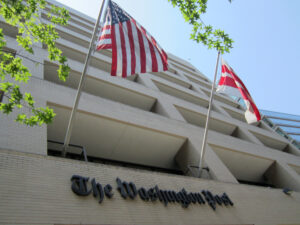
The Washington Post building in Washington, D.C. Photo from Wikimedia Commons taken by Daniel X. O’Neil under Creative Commons Attribution 2.0.
The raid and confiscation of materials from the home of Washington Post reporter Hannah Natanson Jan. 14 is just the latest example of the assault on press freedom and, of course, the First Amendment.
According to reporting in the Washington Post, “…. Federal agents searched her home and her devices, seizing her phone, two laptops and a Garmin watch. One of the laptops was her personal computer, the other a Post-issued laptop.”
Post Executive Editor Matt Murray called the search an “extraordinary, aggressive action” that is “deeply concerning and raises profound questions and concern around the constitutional protections for our work.”
That’s an understatement.
Fortunately, as I was putting the final touches on this piece Feb. 24, The Washington Post reported:
“….A federal judge in Virginia rejected the Justice Department’s request to search through a Washington Post reporter’s electronic devices as part of a national security leak investigation, ruling that the court would instead be responsible for conducting the search.
The Tuesday ruling suggested that Magistrate Judge William Porter did not trust the government to conduct a narrow search of the devices and feared that such an examination could risk exposing more than 1,000 of the reporter’s government sources to the Justice Department.”
The scary part? The fact that Judge Porter “…did not trust the government to conduct a narrow search of the devices…” The full coverage from WaPo’s Feb. 24 story can be found here.
A lack of trust in the government related to seizure of materials legally obtained by a reporter adds credence to the fact that the unprecedent assault on press rights and the First Amendment does more than challenge the practice of journalism: it poses challenges to journalism education.
No longer can journalism educators merely tout the First Amendment and focus on prior review, prior restraint and censorship. They’ll need to look at the press control banter being preached from the White House and its potential impact down to the journalism classroom.
Much in the way that Ronald Regan touted the theory suggesting that tax cuts and financial benefits for corporations and the wealthy will stimulate economic growth, ultimately benefiting everyone through job creation and higher wages as “Trickledown economics,” actions by the Department of Justice and allegations by United States Attorney General Pam Bondi could be dubbed “Trickledown Censorship”
While discussions, no doubt, have and will continue in classrooms about the assault on the First Amendment by the Trump Administration, the question that remains is what and how should teachers address the issues surrounding journalism today.
While the current administration is front and center in media harassment, history will show, sadly, that it’s not the only case.
It does not take much to set the way-back machine to August 2023 when the offices of the Marion County Record in Marion, Kansas, were raided by Marion County and Marion city law enforcement agencies allegedly because, according to reporting in the New York Times, “…appeared to be linked to an investigation into how a document containing information about a local restaurateur found its way to the local newspaper — and whether the restaurant owner’s privacy was violated in the process.”

Police in Marion, Kansas, are seen on surveillance video raiding the Marion County Record newspaper office. Screenshot from public records.
Equipment, reporters notes and documents from the Record were seized without due cause in a raid so horrific that it is believed to have contributed to the death Joan Meyer, the 98-year-old co-owner and publisher of the Record.
The savage nature of the event is well documented and students can easily study and learn about the raid. They can also learn about the November 2025 settlement in which Marion County authorities agreed to pay a $3 million settlement because of their actions.
According to The Kansas Reflector, which touts itself as “a nonprofit news operation providing in-depth reporting, diverse opinions and daily coverage of state government and politics. This public service is free to readers and other news outlets,” the settlement also included a “statement of regret”, which reads:
“The Sheriff’s Office wishes to express its sincere regrets to Eric and Joan Meyer and Ruth and Ronald Herbel for its participation in the drafting and execution of the Marion Police Department’s search warrants on their homes and the Marion County Record. This likely would not have happened if established law had been reviewed and applied prior to the execution of the warrants.”
Eric Meyer is the owner and editor of the Marion County Record and Ruth Herbel is the Marion city councilor whose home was raided in tandem with the newspaper office. Joan Meyer was Eric Meyer’s mother who died the day after the raid and Ronald Herbel is Ruth Herbel’s husband.
While the settlement includes an admission of remorse by the County and provides financial help for the Record to recoup some of the cost of equipment, lost sales and operating expenses, the fact remains that government agencies still saw fit to attack a media outlet simply because of content they perceived to be unfit.
As journalism advocates and educators, it is incumbent on all of us to, as I have said before, to not only teach press rights and the First Amendment, but to vigilantly defend and support them.
Hopefully, a student media outlet will never be subjected to this kind of treatment. That doesn’t mean cases like Hannah Natanson’s or the Marion County Record should be overlooked or left out of a journalism curriculum. The reality is that they are brutal reminders of the recent and, unfortunately, ongoing, assault on American Journalism.
As new cases unfold on a seemingly regular basis, journalism educators at all levels need to address the situations and discuss them with their students. These discussions should address not only the nature of the cases, but resources available to student journalists. There are, to no surprise, a plethora of resources available including, but not limited to, the Society of Professional Journalists, the Student Press Law Center, The Freedom of the Press Foundation, the American Press Institute and the Freedom Forum.
Even with the settlement in Kansas, the question remains — Is the settlement worth celebrating? It is because it seemingly absolves The Record of any wrongdoing and places the blame for the horrific raid on Marion County and city officials.
Nonetheless, one thing remains certain — no matter how much the settlement was — Press Rights are not for sale.
It has become an ongoing battle. And we’re all in it together.
Written By: Stan Zoller, MJE