

A road map for advisers and student journalists who want to change minds during SJW and beyond
As a journalism adviser, I work daily to empower my student journalists, encouraging them to seek truth and report it in the most ethical way possible and teaching them the skills they need to do this important work. But from the beginning of the year, we start with the “why”: Why do we need journalists? Why is it important to be able to identify misinformation? Why is the “watchdog” role so important to a democracy?
I feel confident that our journalism students — the majority of them, anyway — leave our classes understanding journalism’s crucial role in our society and taking pride in their roles as truth-tellers. But what about the students we never teach, especially in schools without media literacy training? According to the News Literacy Project’s 2025 report, “‘Biased,” “Boring” and “Bad’: Unpacking perceptions of news media and journalism among U.S. teens,” the average teen perception doesn’t look good.
Some of the grim findings NLP highlighted in their introduction:
- Almost half of teens (45%), said journalists do more harm to democracy than protect it.
- Only a little over half of teens (56%) believed that journalists and news organizations take journalism standards such as accuracy and fairness seriously in their work.
- The majority of teens (80%) said that journalists fail to produce information that is more impartial than other content creators online.
- Nearly 7 in 10 teens (69%) thought that news organizations intentionally add bias to coverage to advance a specific perspective.
In the months since this report came out, I’ve been thinking a lot about how we got here and how journalism advisers can work with our staffs to actively counteract these beliefs. I started with a conversation with my students. In the fall, we looked at the report’s findings, and they shared their thoughts about why their peers feel the way they do. Unsurprisingly, social media and AI came up a lot. Teens have grown up in a saturated social media culture, listening to hot takes on current events from influencers and not understanding the difference between pure opinion, news analysis and objective reporting. In recent years, they’ve learned not to trust what they see and hear since AI-generated tools have become more and more convincing, and anyone can make fake images and videos. The Oracle editorial board wrote about this in their December editorial, “AI’s threat to our shared sense of reality,” but we knew we wanted to do more.
I’m lucky to work with phenomenal educators at my school, and media literacy is a core part of our curriculum. Still, AI technology is evolving at a dizzying speed, and many don’t explicitly teach the concept of standards-based journalism. I’m working with my students to change that during Scholastic Journalism Week.
Because the yearbook staff is on very tight deadlines this time of the year with our final print submission date looming, my Oracle staff takes the lead during SJW. I hope this provides a road map other advisers might find useful now or in the future.
News Literacy Project Resources: JEA has phenomenal curriculum resources, of course, but I also want to shout out the incredible resources on the News Literacy Project’s website, free once you register. Their Checkology modules are fantastic. Teachers can choose from pre-packaged units on news literacy and learning basic journalism skills or create their own course tailored for their specific class. I do this for all of my intro students during the first semester. I also highly recommend subscribing to their Sift newsletter, which provides excellent bell-ringers and slides teachers can use in their classrooms right away. The format is easy to read and includes Daily Do Now slides, Top Picks, discussion prompts, related resources, “Rumor Guard” and “kickers” on other topics. As I write this, the most recent newsletter has resources about preserving Black newspapers, prompts about the significance of journalists being arrested in Minneapolis, content about how AI Slop is perpetuating Holocaust misinformation and more. Their Instagram account is also excellent, providing timely reels about these topics in a student-friendly format.
Initial Presentation: We are a small grades six through 12 school with middle and upper school divisions. My student SJW presentation team is preparing a presentation for both groups. Before they get into a discussion of what SJW is and how they will be celebrating each day, they are drawing on NLP resources. They plan to start with this NLP reel about Sora and ask students why this is a problem for basic news literacy. They will then introduce the concept of standards-based journalism, using the seven standards the NLP outlines in a helpful poster. Then, they will make the essential connection: Because standards-based news media won’t publish videos and photos it can’t verify, consumers can trust their content. They will explain that our scholastic media program follows the same standards-based approach, which includes clearly labeling opinion. Only then will the presenters shift into a discussion of why they are leading a celebration of scholastic journalism during SJW. During the presentation, they plan to use interactive strategies, such as turn-and-talk followed by volunteers sharing takeaways, and a final “ticket to leave” where the peers share what they learned. They plan to post a sampling of those takeaways on a bulletin board for all to see. .
SJW Celebrations: My editors divided our staff into five teams, one for each day. Each team is responsible for bringing that day’s theme to life. I created a planning doc with links to JEA’s fantastic SJW resources website and then let student editors lead their teams to plan their approach. This is a graded assignment with clear criteria for success. I use the following prompts to help them to plan:
- What’s our angle on this day’s theme?
- Article/Multimedia Plan:
- Social Media:
- Courtyard Table (who will sit at it; how you will bring the day’s theme to life):
- Extras/Fun stuff:
- How will you ensure every single member of your group has something meaningful to do to contribute to this day?
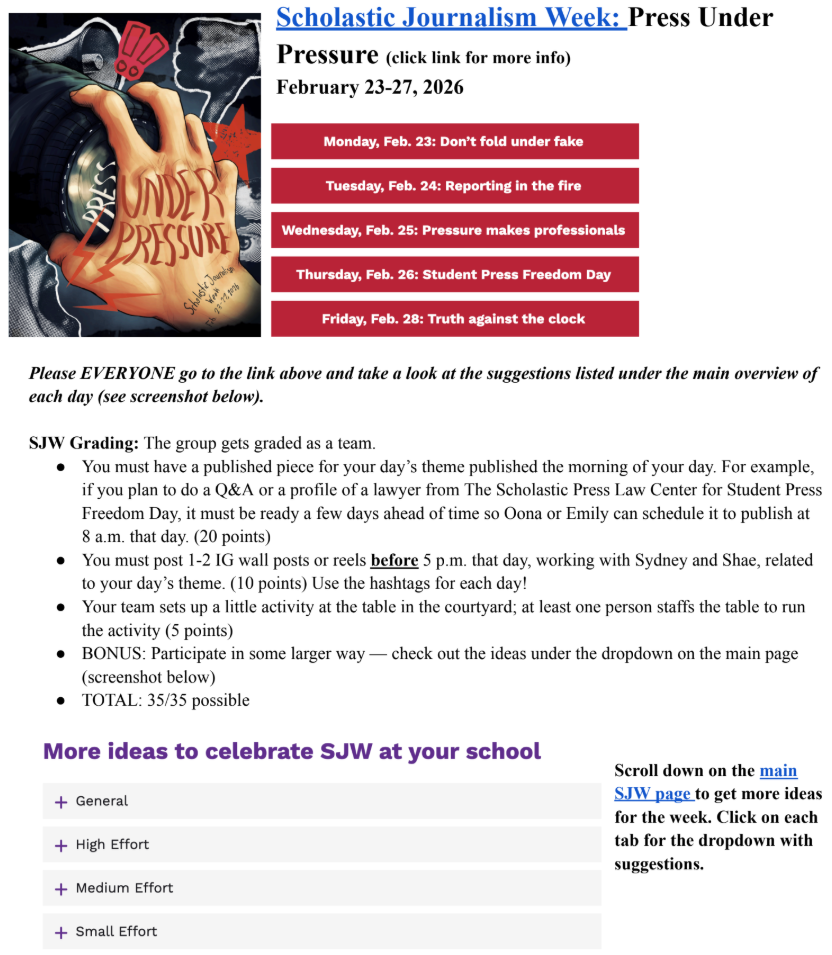
The Scholastic Journalism Website offers a plethora of resources for schools that would like to participate, including the theme days referenced above.
Follow-Up: After SJW, we will debrief as a staff and evaluate how it went. I always end with a reminder: It takes more than a single presentation and a week of celebration to change teens’ minds about the value of standards-based journalism. How can we carry this forward all year round?
Although it’s easy to feel defeated by studies about teens’ beliefs around standards-based journalism, allowing our journalism students to dig into the problem and work to solve it can be an incredible source of hope. If you missed SJW this year, don’t feel like you’ve missed the chance to be part of the solution. Presentations, info sessions and student-led initiatives are evergreen. I promise you’ll come out the other side feeling better.
Written By: Kristin Taylor, MJE