

Finding new ways to invite dialogue about the First Amendment feels tricky sometimes, especially when veteran staff members have experienced my lessons and activities more than once. Lately I’ve tried to develop some fun and open-ended ways for students to reflect, create, share — and sometimes compete — while maintaining our commitment to celebrating student press freedom.
I’m sharing one such activity that may be something others would enjoy, too. It’s simple.
First, invite students to do a quick write, table talk or pair-share based on these questions for reflection:
- What does the First Amendment mean to you personally? Why/how is it connected to some aspect of your life? Provide at least one example. You can include your role in student media or you can go in another direction.
- As a teen and as a high school student, do you feel like your FA rights are supported in today’s society? In our community? In school? What reinforces your opinion or experience of this, and if you feel like your FA rights are threatened or less protected, explain why.
- What do you think is most important for students at our school to know about the First Amendment?
Next, divide students into groups and engage in a First Amendment song competition using Suno, a free AI music tool. Assign them to collaborate based on the reflection questions to determine a main idea or angle and craft their own original paragraph to use as the starting point. Once students do the main thinking and decision making, they can play with the music generator to determine genre, speed, style and other fun elements in order to create a song. It’s hilarious.
Here are some examples, which represent a huge variety in quality and style:
1 – “First Things First”
2 – “Speak Your Mind”
3 – “Aria of Open Voices”
4 – “First Amendment Fire”
5 – “Amendment Yell”
6 – “First Amendment Song”
7 – “The First Amendment Helps Teenagers”
8 – “The First Amendment Gives Us Freedom”
From here, of course, there’s tons you can do once you’re done laughing and voting for a winning song. (If you don’t have time to do this, or if any kind of tech rules prevent your students from making free accounts, feel free to use my students’ excerpts for discussion instead.)
After playing each group’s song aloud in class, I led a discussion and asked students to critique the accuracy and relevance of their song lyrics. We found some places where AI got it wrong (as is usually the case), so groups took turns pointing out weak or misleading lyrics. This was probably the most beneficial part of the lesson and created opportunities for our staff mentors to review or break down certain parts for our younger staff members.
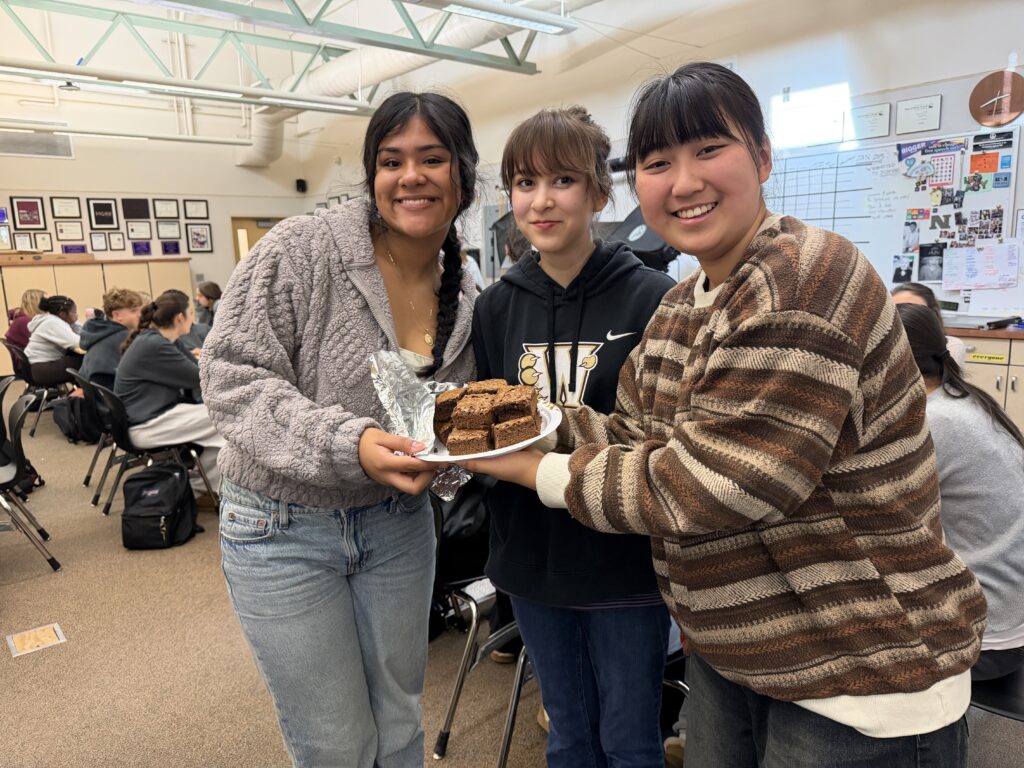
The students from the winning group enjoy their prize (homemade brownies from their adviser). Photo by Sarah Nichols, MJE.
This led to a mini-lesson tweaking AI prompts and comparing how certain tools yield different results, helping students refine their key word phrasing and getting more specific on their message. Our editorial policy, developed and reviewed annually by my staff, dictates they won’t use AI in any part of our student media program. But I feel strongly I should be helping students navigate these tools and related issues. To me, this was a way we could work through the pros and cons of one AI tool through the lens of ongoing First Amendment education.
To them, it was a fun competition with music involved. So I’ll take the win.
I’d love to hear your best “Resilience in Action” or “Press Under Pressure” songs if your staff decides to try this as you celebrate Student Press Freedom Day and Scholastic Journalism Week.
Written By: Sarah Nichols, MJE