

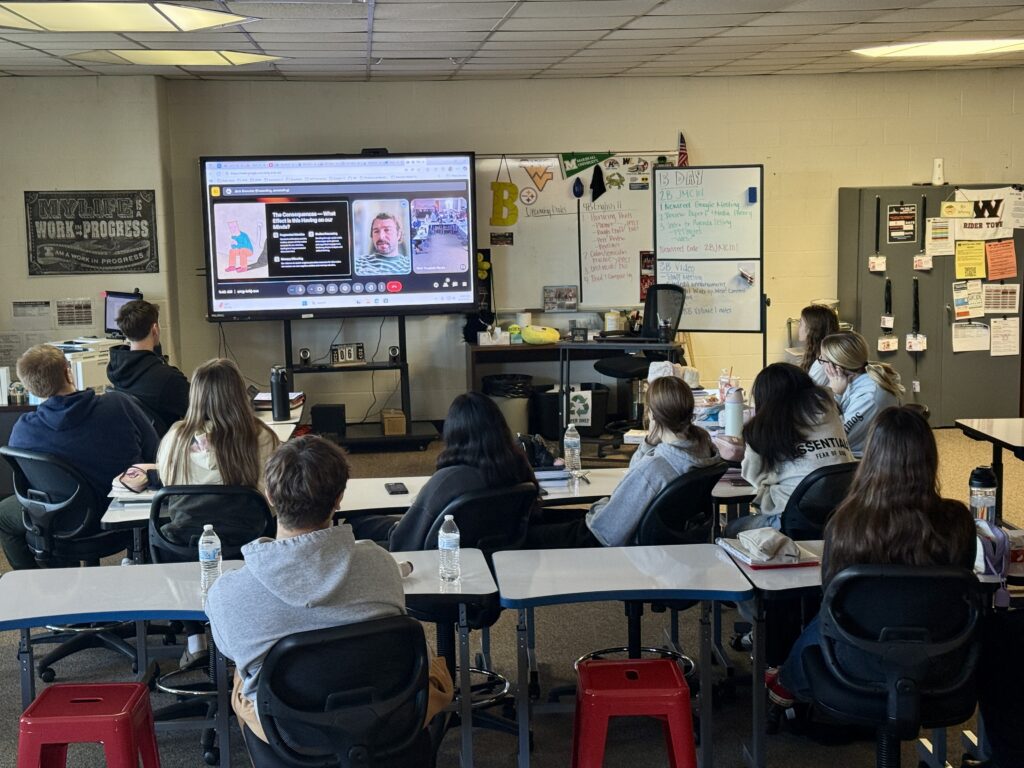
Weir High School students in Morgan Bricker’s Journalism 1 class participate in a Zoom call with Jack Brewster, founder of the Newsreel app, to discuss the importance of news literacy and ways that apps like his can help them be more responsible consumers and creators of news.
By Candace Bowen, MJE
When the News Literacy Project looked at teen attitudes toward news media in 2024, the results were depressing.
Forty-five percent said they believed journalists and news organizations “do more to harm democracy than to protect it.” Also, almost 70% thought news organizations “intentionally add bias to coverage to advance a specific perspective.”
These and other findings were concerning for anyone who thinks of news media as the fourth estimate, the watchdog of government and an important way to protect our democracy.
In hopes of understanding teen views better – and maybe finding a little bit more encouraging results – the News Literacy Project arranged to have 750 of the original teens contacted again with follow-up questions. Their findings were published in “Biased,” “Boring” and “Bad”: Unpacking perceptions of news media and journalism among U.S. teens, by Kim Bowman and Peter Adams, 2025.
Sadly, the results are not encouraging. Asked for a word describing news media, 83% offered a negative word, such as inaccurate/deceptive, biased or poor quality.
Only 9% used a positive word like entertaining or informative.
But some of this may come from a lack of understanding of what it means to be a journalist. When asked about professional journalists and their organization correcting errors, 39% said “sometimes,” 31% said “rarely” and 8% said “never.” Asked if professional journalists and their news organizations “gather information from multiple sources to get the whole story,” 71% said “sometimes,” “rarely,” or “never.” More than half indicated they believe “journalists frequently pay or do favors for sources in exchange of information or special access.” And half said “journalists make up details, such as quotes.”
Some the report acknowledges – and many of us know from personal experience – these reactions often come from each person’s definition of “journalism.” If the online media “influencer” is their idea of a journalist, that’s a problem. Or if they get their “news” from Facebook friends’ profiles, that’s a problem. If they don’t know how to check and double check a “journalist’s” resources, that’s a problem, too.
Scary, right? So, what, if anything, can today’s journalism teachers/media advisers and their staffs do about this in their own communities? These are the boots on the ground when it comes to journalism and its intersection with teens. I would love to get a discussion going with JEA members. I know some have used various approaches to understanding news and gaining news literacy as part of Scholastic Journalism Week. Others may have ways to teach a bit about the standards of media ethics and attitudes. When we had the JEAHelp listserv, we could have instantly started a conversation, but the forum section of the JEA.org website allows that, too. It just will take a few more steps.
Here’s my idea: After this blog is posted, I’ll start a discussion thread in the Press Rights forum area of JEA.org. To add your thoughts and see those of others, once you’re logged in to the website, go to the purple sidebar on the left, scroll down and choose FORUM (near the bottom of the list), and, then go to the far right side of the screen and, under JEA Forums, choose Press Rights – and this will probably be the top one. While not totally inspired with an official topic yet, it will be something about “Changing views of news.” Let’s see if we can come up with some plans others can use, too. If we get enough responses, I can write a follow-up blog before the end of the school year to highlight what other students have suggested and enable you to share these with your staffs.
Let’s hope teachers and students creating high school media know best the ethics and reliability of true journalists and can help convince their classmates there are plenty of reasons to trust and support journalists.
Written By: Candace Bowen, MJE