

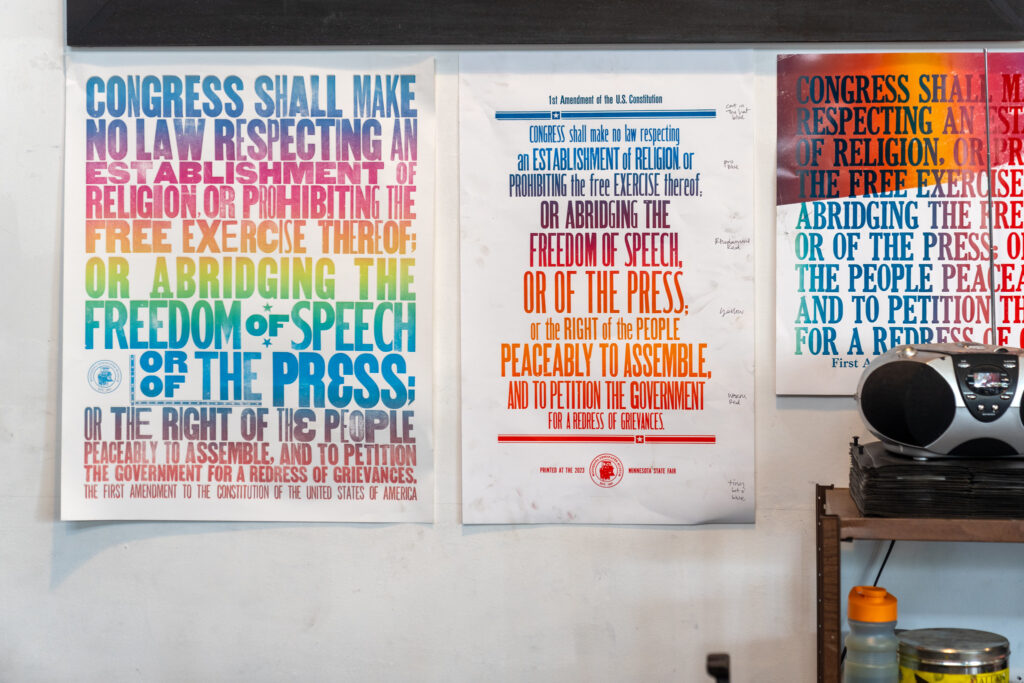
“First Amendment Freedom of the Press poster at the Minnesota Newspaper Museum at the Minnesota State Fair” taken and shared by Lorie Shaull on Flickr.
By Stan Zoller, MJE
Ten years ago, I was finishing up my term as President of the Chicago Headline Club, the largest local SPJ chapter in the country.
It was an honor to be at the helm of the club surrounded by some of the most outstanding journalists with which I had the pleasure to be associated.
In addition to our passion for providing Chicago area journalists with a plethora of programming, we were unified in promoting and practicing our motto.
Defending the public’s right to know.
While transparency, accountability, ethics and accuracy are the core of defending the public’s right to know, it’s the foundation that anchors it – the First Amendment.
It is, and should be, the centerpiece of any journalism education program and emblazoned on the minds of every student journalist and journalism educator.
For without it, we would be, with apologies to the band Kansas, dust in the wind.
It’s not breaking news, but the winds of journalism are blowing harder than ever before, and journalists need to practice their craft like they never have to do to avoid becoming dust.
We all know that. But what can the journalism community – from scholastic to mainstream – do?
As I recently wrote in C:JET magazine, with the bar seemingly being raised on a daily basis, journalists need to be on their proverbial “A Game” on a regular basis. Outside of newsroom or classroom, they need to advocate for First Amendment rights by contacting lawmakers at all levels while also making their voices heard at school board meetings, city council meetings and public rallies.
Quite simply, we are all soldiers in the war to preserve, protect and practice the First Amendment.
The fight entails more than memorizing 45 words, it’s accepting the challenges the First Amendment brings with it.
It’s challenging reporters to do their best work.
It’s challenging citizens to hold their government officials — from county boards to school boards to be accountable and transparent.
It’s challenging journalists to hold government officials transparent and accountable – and this includes student journalists who cover their school boards.
Student journalists and journalism advisers must also take the message out of the classroom. They are the poster people for all the First Amendment has to offer. School administrators should be stewards of the rights of the First Amendment, but all too often they tow the “company line” and take a passive approach, which is not only detrimental to a journalism curriculum, but also to civics education.
Proponents of civics education will unequivocally tout the importance of a vibrant, free and responsible media in civics, but yet there are schools that say one thing in the civics classroom and another in the journalism classroom.
Obviously, journalism educators and their students must be advocates of the First Amendment both in and out of the school building. Much in the same way news consumers turn to journalists for information, they should also turn to journalists as staunch defenders of freedoms in the United States and the best place to start is with the First Amendment.
Advocacy for the First Amendment is at the root of JEA’s Candace and John Bowen Adviser First Amendment Leadership Award, an honor that was bestowed on me at the 2024 JEA/NSPA National High School Journalism Convention in Philadelphia. To say I was, and still am, proud to be the first recipient is an understatement.
Other journalism educators need to share the pride and honor of receiving the award named for two of the most amazing and ardent fighters of First Amendment rights for scholastic journalism.
If you know someone you think is deserving of the award, nominate them. Think of someone whose practice of the First Amendment aids not only their students, but also colleagues who come under fire. Think of someone who participates or leads the charge when student press rights are challenged by elected officials or members of the general public who think student journalists should be seen, but not heard. You can find full details about the award here.
The deadline is Dec. 15.
Believe me, it’s incredible honor. But the First Amendment is incredible.
Written By: Stan Zoller, MJE