
Curriculum Library
The JEA Curriculum Initiative shares lesson plans across 11 different content areas, complete with learning outcomes, assessments, evaluation guides, models and alignment to standards including the Common Core and Partnership for 21st Century Skills. Today, we proudly offer hundreds of weeks worth of lessons to complement high school journalism classrooms across the country. This content is available exclusively to all JEA members.
There are many free resources available to the public on the Anywhere JEA page, and some other curriculum falls into groups easily navigated using Curriculum Maps.
Additionally, you'll find a helpful guide to the curriculum library HERE organized by category and lesson order.
Thank you for checking out the JEA curriculum library. JEA updated our website Sept. 11. We appreciate your patience as our curriculum team continues to update links to some of the downloads and activities throughout the library in the coming weeks.
Questions or concerns? Email JEA Curriculum Specialist Jim Streisel directly, or, more broadly, email staff@jea.org the name of the lesson (include the URL) you are trying to access as we may be able to send it to you directly.
Free
Weekly Lesson
Each week, we share a free curriculum lesson on a timely topic. These lessons are free to everyone for a limited period of time. After that, the lessons live in the curriculum library which is accessible only to JEA members. Click here to learn more about membership.
Conducting the First Interview
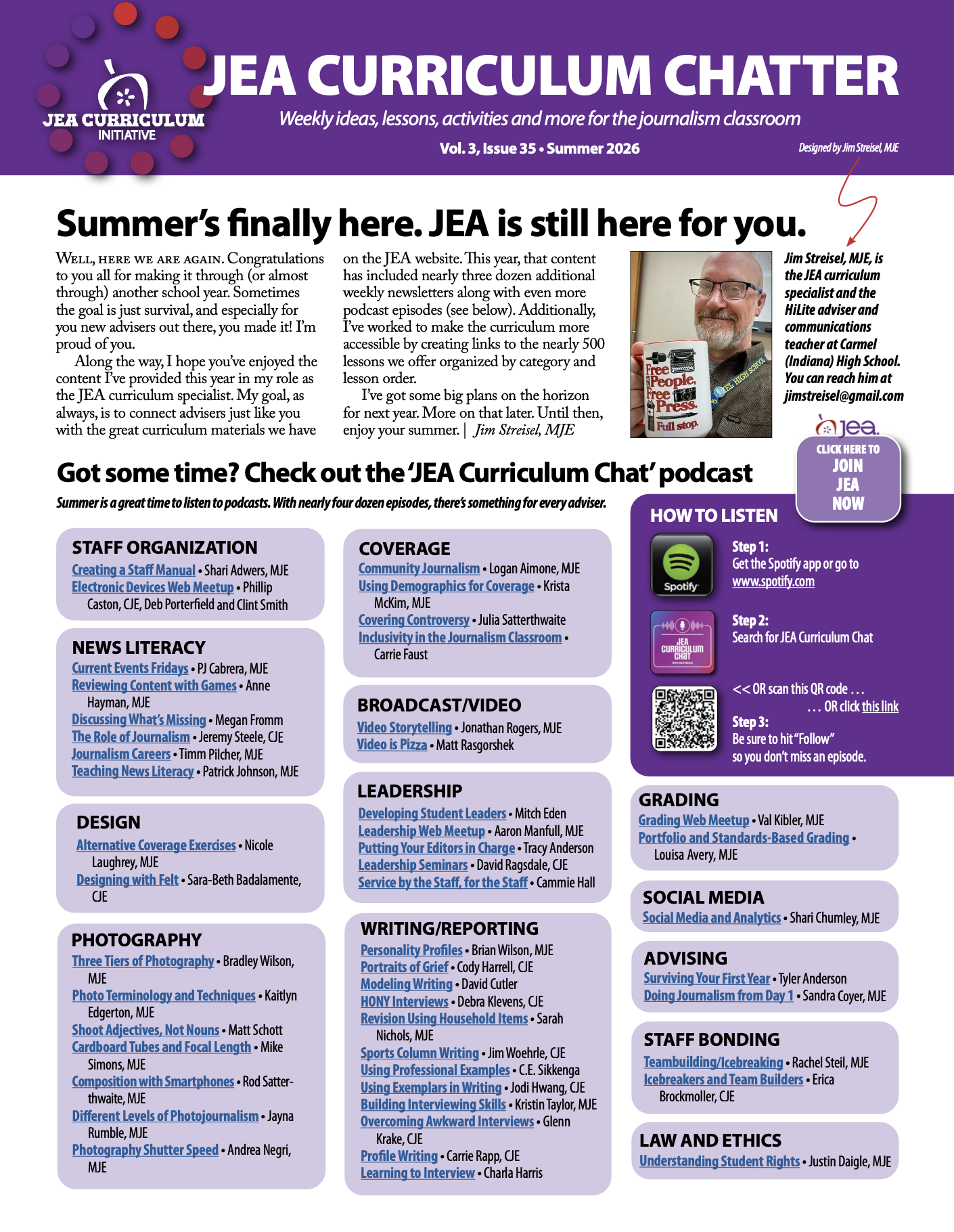
This lesson asks students to interview a classmate as preparation for writing the beginning of one of the most basic journalistic forms: a profile story based on interviews of a single source.Summer 2026 Curriculum
Curriculum Library
Covering the school board
This lesson introduces students to viewing school board meetings and interpreting school board minutes.Election Coverage
This lesson on election coverage moves students through critical-thinking and decision-making processes, then prompts them to cover stories communities need.The Power of “How” and “Why”: How Curiosity Can Lead to Great Storytelling
In this lesson, students will be encouraged to think of themselves as “explorers of the world” and will consider the value of asking “how” and “why” in an interview.Humans of Your School Personality Profile
Students will have an opportunity to practice all aspects of yearbook journalism and to learn the process.Digital note-taking tools experiment
Students will apply research, observation and note-taking skills to synthesize a new method of news gathering with digital note-taking apps such as Evernote and Google Keep.Pitch in: Elements of Story Pitch Meetings
Students will analyze how to use the 5Ws and H to test their story idea and present in a concise manner.Digital Dictation Tools
Students will explore digital tools to capture and transcribe interviews.Establishing and Nurturing Relationships in Beat Reporting
Students will understand and operate a beat reporting system.Using Social Media to Cultivate Coverage
Students will review and evaluate professional and other media staffs’ methods of storytelling on a variety of social media platforms.Finding stories in data
This lesson helps students begin to identify potential story ideas in data they have collected and introduces students to resources they can use to help visualize that data.Using descriptive statistics to analyze data
This lesson introduces students to basic descriptive statistics used for initial data analysis.Introduction to spreadsheets
This lesson introduces students to working with spreadsheets in Microsoft Excel, Google Forms and Google Sheets.JEA Curriculum Chat Podcast
Listen to the most recent episode.
About Curriculum & The Team
In May 2013, the Journalism Education Association began work on its curriculum initiative, creating lesson plans across 14 content areas, complete with learning outcomes, assessments, evaluation guides, models and alignment to standards including the Common Core and Partnership for 21st Century Skills.
Over the course of the next 11 months, JEA worked with 14 of its members — identified as national leaders in their area of expertise — to develop nearly 200 weeks worth of lessons to complement high school journalism classrooms across the country. Helping them were dozens of other JEA members, professionals and student journalists who volunteered their own ideas, materials and examples to benefit scholastic media advisers.
As important as this electronic resource is, it’s merely a portion of JEA’s curriculum initiative. Just as important is the ongoing commitment the organization is making to the effort. Curriculum leaders keep the curriculum current and dynamic by providing updated lesson plans and examples that reflect the newest trends and technology. They collaborate with other JEA committees such as certification and Career & Technical Education to ensure that the organization is at the forefront of defining 21st century journalism. They coordinate with our national Professional Advisory Committee to ensure our student learning objectives align with industry standards. They showcase their curriculum and lessons at national conventions and conferences. And they host online chats to not only discuss implementation of their module, but to coordinate discussion of best practices that will guide future development.
We welcome your feedback, suggestions, plaudits and corrections. Please feel free to email mfromm@d51schools.org, or contact specific curriculum leaders directly.